Showing posts with label Gastrointestinal. Show all posts

Monday, September 24, 2007

Passing Gas

We all do it, some more than others, and it is a common complaint in my office. Well I mean it is a common complaint that I hear from my patients who are seeking care about flatus (gas that is passed from the anus) as opposed to gas that is passed from the mouth(belching or burping) and gas that is stuck in purgatory(bloating).

What is the normal amount of gas to pass?
It is normal to pass gas 6-25 times a day.

What is gas?
Intestinal gas is made up of oxygen, nitrogen, carbon dioxide, hydrogen, ammonia, methane, and hydrogen sulfide. The latter 3 gases account for the more toxic levels of the odor. The composition of the gas varies depending on the types of intestinal bacteria that are present.

What produces gas?
The large intestine (colon) contains many bacteria, fungi, and yeast. As food passes through the intestinal tract, some of the carbohydrates remain undigested as they reach the large intestine. These organisms enjoy the undigested carbohydrates and break the carbohydrates down and produce gas as the byproduct.

What increases gas?
The most common factors which contribute to gas production are eating patterns and bacterial composition of the intestine.

Foods that cause an increase in gas production include:
--Milk products especially if you are lactose-intolerant which means that you do not have the enzyme lactase needed to digest the carbohydrate, lactose.
--Carbonated beverages
--Spicy, fried or fatty foods
--Broccoli, cabbage, onions, celery
--Beans
--Apple or prune juice
--Dried fruits
--Anything containing sorbitol, mannitol or maltitol, found in many low-carb or sugar-free foods

Other factors that increase gas production include:
--Anything that increases swallowing of air such as talking while eating, chewing gum or sucking on candy, using a straw or sports bottle, deep sighing, smoking or chewing tobacco, or ill fitting dentures.
--Tight-fitting garments
--Long-term use of medications for relief of cold symptoms
--Smoking or chewing tobacco
--Overloading your stomach
--Hormonal changes such as during menstrual cycle
--Constipation or Irritable Bowel Syndrome

What decreases gas?
Other than altering the flatugenic behaviors already mentioned, these remedies may be helpful.
--Lactase found in products such as Lactaid can be taken to help with the digestion of lactose when consuming dairy products.
--Beano contains the enzyme which breaks down raffinose, the carbohydrate in beans.
--Simethicone (Gas-X, Mylicon) breaks down the gas bubbles to help dissolve them.--Some natural remedies include peppermint and chamomile tea, fennel, anise, and turmeric.
--Fiber products such as Metamucil and Citrucel may also be helpful if Irritable Bowel Syndrome is present. However, these products may initially increase gas.

It is advised to seek medical attention if gas production is accompanied by weight loss, diarrhea, vomiting, heartburn or blood in the stool, or if there is an increase in frequency, location or severity of the symptom.


References: Brigham and Women's Hospital.
Photo: courtesy of Medline.

Friday, November 24, 2006

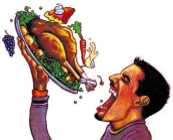
I Can't Believe I Ate the Whole Thing


The day after Thanksgiving is not only the beginning of the shopping season, but it's also the beginning of the heartburn season.

Heartburn is the sensation of pain, burning, or pressure in your chest which usually occurs after a meal especially a large or rich meal. Other symptoms include a sour taste in the mouth, regurgitation of the food, hoarseness, difficulty swallowing, sore throat, coughing, or wheezing.

Heartburn is a symptom of gastroesophogeal reflux disease (GERD) which is caused by a back flow of stomach acid into the esophagus. This is due to a weakening of the valve, the lower esophageal sphincter, which normally holds the stomach content in place. Factors contributing to GERD or heartburn are the following:


  • Alcohol use
  • Overweight
  • Smoking
  • Pregnancy
  • Certain foods such as chocolate, caffeine, garlic, onions, mint, citrus or spicy foods.
  • Large meals, or lying down or bending down after a meal.

There are several over the counter medications available to treat heartburn. This gives an idea of how common the condition is.

  • Antacids such as Maalox, Mylanta, or Tums are fast acting because they neutralize the acid, but their effect is short lived.
  • H-2-receptor blockers such as Zantac (ranitidine), Tagamet (cimetidine), or Pepcid (famotidine) reduce the amount of acid production. They take a bit longer to work, but they provide a longer duration of relief of symptoms.
  • Proton pump inhibitors such as Prilosec (omeprazole) stop acid production. Omeprazole is the only one that is currently available over the counter. This is usually used in more persistent cases and to allow healing of the esophagus.
Heartburn is common. It is considered benign if it occurs less than 3-4 times a month. In these cases simple lifestyle changes which avoid the triggers or taking antacids takes care of the problem.

However, if the symptoms are occurring on a regular basis, if they are not resolving with the usual over the counter medications, or if they are waking you up at night then you should contact your doctor. Heartburn symptoms could also signal more serious conditions such as an ulcer or esophagitis (irritation of the lining of the esophagus).

If untreated, the prolonged exposure to the acid can damage the lining of the esophagus and lead to a condition called Barrett's esophagus. This condition is associated with an increased risk of esophageal cancer. It is uncommon and the risk of developing cancer is about 1% per year, but regular follow up with a physician is necessary if this condition is diagnosed. It may only be diagnosed by an upper endoscopy.

Finally it should be noted that the pain of a heart attack may present like heartburn. If you have other risk factors for heart disease such as obesity, smoking, high blood pressure or high cholesterol, of if this is your first episode of heartburn type symptom then contact your doctor for advice.

References: please see links.
Photo: courtesy of overeating.


Tuesday, November 21, 2006

Colonoscopy to Detect Colon Cancer

Colorectal cancer is second only to lung cancer as the most common cause of cancer death. While many cancers are difficult to screen or prevent, colon cancer can be easily detected in its early stages by a colonoscopy. The American Cancer Society recommends that beginning at age 50 a colon cancer screening test should be done. If there is a family history of colorectal cancer in a first degree relative, then the test may need to be done sooner than age 50, usually about 10 years before the age of diagnosis of the family member. For details of the recommendations see here.

There are several colon cancer screening tests that are available. My preferences and the standard of care in my community are to do the following tests:
--Fecal occult blood tests every year. A card is given to the patient and the test is done at home.
--Colonoscopy may be the most effective screening test for colon cancer. It is recommended every 10 years if the initial colonoscopy is normal. For a first hand personal experience of the procedure by a blogger read here.

Other tests which are also available and recommended by ACS, but which I do not suggest for my patients are:
--Flexible sigmoidoscopy every 5 years. This tool examines the lower 60 cm of the large intestines. However, it may miss cancers that are higher up in the intestine.
--Double-contrast barium enema every 5 years. A chalky substance, barium, and air is inserted into the large intestine and then xrays are taken. This test can be painful and exposes you to some radiation without giving the operator of the procedure a chance to remove a suspicious lesion or polyp if seen. If any abnormalities are seen with either of these procedures, a colonoscopy would then be indicated.
--Virtual colonosocpy is still under investigation. It allows visualization without access to the polyp for removal.

"Bottom" line: colonoscopy is still considered the gold standard for detection of colon cancer. If you have concerns regarding the procedure discuss it with your doctor. And remember like most things in life, the anticipation is worse than the deed.

References: please see specific links.